My research brings actionable data to lawmakers and informs public discourse about the finance of higher education. I pride myself on producing research that is innovative, rigorous, and relevant, illuminating new insights on student loans, college affordability, and financial aid applications.
Student loan debt
My research on student loans has provided lawmakers new insights into how student loan policies shape families’ economic circumstances.
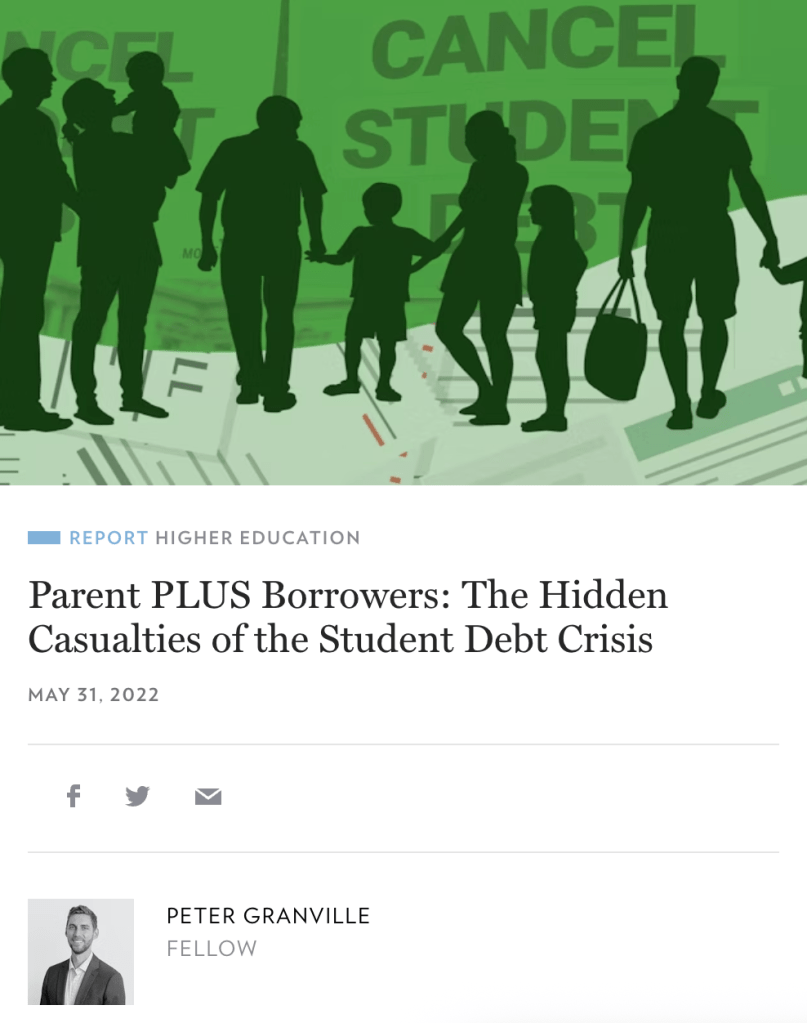
In 2022, my report Parent PLUS Borrowers: The Hidden Casualties of the Student Debt Crisis provided new insights into Parent PLUS loan borrowing, including in-depth analysis of how Parent PLUS repayment rates differ by demographics. This report has been cited by members of the U.S. Senate in letters to President Biden and Secretary Cardona, alongside such outlets as The New York Times, and it played a role in the design of President Biden’s student loan forgiveness plan announced August 2022.
In 2025, my report The FICO Factor: GOP Megabill Will Limit Who Gets to Access College was the first analysis to fully examine how students would fare in the private loan market, following the One Big Beautiful Bill Act’s loan caps. The report was the first to use credit score data to estimate the share of adults who would be unable to secure a private student loan for themselves or a family member (38%), and it raised the alarm for policymakers concerned about the private loan market.
More of my student debt publications:
- How President Biden’s Student Debt Cancellation Plan Helps Parent Borrowers (2022).
- The Student Loan Borrowing Undermining California’s Affordability Efforts (2023).
- The Assault on the SAVE Plan Has Brought Student Debt Relief to a Crossroads (2025).
College affordability
My research on college affordability helps lawmakers envision how policy changes can bring a college degree into the reach of every American.

In 2021, I built a cost model to guide debate about President Biden’s free community college plan, in a report titled Congress’s Free Community College Plan Could Benefit 8 Million Students, with the Right Funding Formula. Through this cost model, I enabled lawmakers to see how policy design choices would trigger different outcomes. A follow-up op-ed, “No more kicking the can down the road on free community college,” was published by The Hill that November.
In 2023, my research report How America’s College Promise Would Reshape the Free College Landscape countered the notion that free college should remain a state issue by contrasting a first-dollar federal benefit with the last-dollar model used by many states.
In 2025, my coauthors and I examined state and institutional grant aid in a report titled A Better Hundred Billion: Improving State and Institutional College Financial Aid. The report includes a data tool I built to allow states to examine how grant aid shapes net price across different groups.
Financial aid applications
My research on financial aid applications has tracked gaps in FAFSA completion rates along lines of income, race, and parental education level.
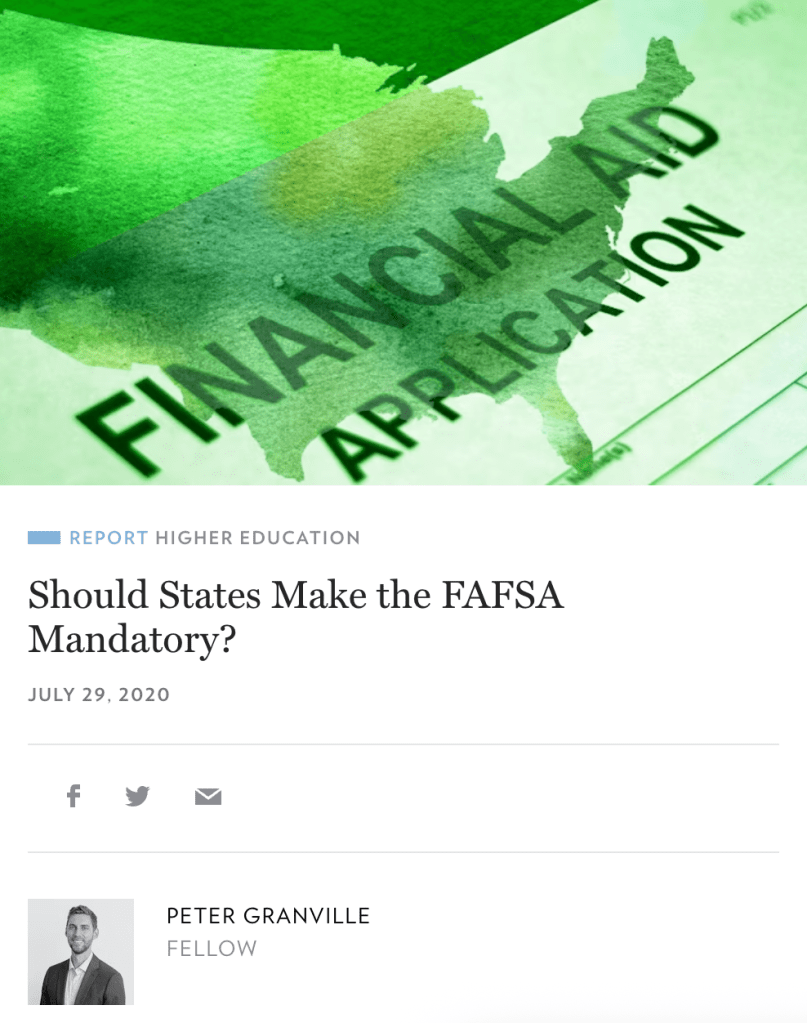
In 2020, my report Should States Make the FAFSA Mandatory? uncovered how Louisiana’s graduation requirement closed gaps by income in FAFSA completion percentage. This research has helped spur the growth of these policies across more than a dozen states. In 2025, I examined several states’ outcomes under these policies in a report titled Mandatory FAFSA Policies Have Had Immediate Impact. My research and quotes on mandatory FAFSA policies have been cited by outlets such as The New York Times and The Wall Street Journal.
In 2024, my report FAFSA Fallout: Application Dropoff Threatening to Widen College Gaps analyzed how the Class of 2024’s FAFSA completion rate dropoff playing out across American communities, revealing diverging trends based on demographics. For this research, I linked Census Bureau data to FAFSA data, which enabled far more in-depth analysis than others had previously published on the topic. I presented this research to a working group of state leaders navigating the decline in FAFSA completions.
Additional higher education research topics
My research in 2019 on college affordability in Michigan helped make a case for greater investments to reduce costs for low-income students, a year before the state created the Michigan Reconnect financial aid program. The research was cited in numerous state news outlets and in a task force report by the Michigan Department of Lifelong Education, Advancement, and Potential (MiLEAP).
My research in 2020 on California college students’ access to SNAP helped advocates spur state legislation to streamline eligibility rules and improve reporting. My research revealed inconsistencies in how California published information about which college programs could be used as exemptions to the ban on student participation in SNAP, which the state then rectified. This research was cited in a task force report by the California Student Aid Commission.
In 2021, I provided the first estimates of the number of college students nationwide (3 million) who became newly eligible for SNAP under temporary rules passed by Congress during the pandemic public health emergency. This research was cited by NPR and helped raise awareness of the reach of the new rules.
In 2023, my coauthor and I projected how students would benefit from the Biden administration’s Gainful Employment rule, projecting that students in failing programs would average nearly $10,000 more in earnings per year by attending their nearest passing program instead. This research was cited by USA Today.
In 2025, my coauthors and I analyzed how the Office for Civil Rights (OCR)’s Dear Colleague Letter, which deemed the use of racial proxies in university decision-making illegal, risked making college less accessible for low-income students of all racial and ethnic identities.
 Peter Granville